Nadia Fettah: Le PLF 2026 consolide la trajectoire du “Maroc émergent” fondée sur un développement inclusif
The Finance Bill (PLF) for the year 2026 embodies the Kingdom’s ongoing efforts to consolidate the foundations of the “Emerging Morocco” trajectory, aimed at achieving inclusive development that combines economic efficiency, social justice, and integrated territorial progress, said the Minister of Economy and Finance, Nadia Fettah, on Thursday at the House of Representatives.

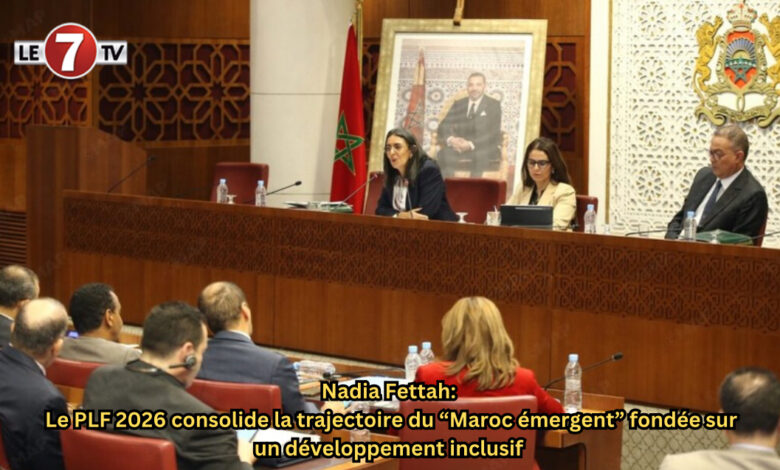
Speaking during the general discussion of the PLF before the Finance and Economic Development Committee, in the presence of the Minister Delegate in charge of the Budget, Fouzi Lekjaa, Ms. Fettah stressed that this project holds strategic importance as it allows for a broader perspective on the achievements accomplished over the past two decades under the enlightened leadership of His Majesty King Mohammed VI.
These achievements, she continued, have profoundly transformed Morocco’s economic and social landscape and helped shape the outlines of a new development model.
According to Ms. Fettah, the 2026 Finance Bill marks a “historic turning point” in public management, through the launch of a new generation of territorial development programs based on the valorization of local specificities, the implementation of advanced regionalization principles, and the promotion of complementarity and solidarity among territories.
These programs, she explained, rely on the convergence of efforts by various public actors around clear priorities and high-impact projects on the ground, with the aim of fostering better territorial coherence and delivering tangible results that serve citizens.
The Minister stated that the PLF 2026 seeks to implement the government’s commitments outlined in the 2021-2026 program, in harmony with the recommendations of the General Report on the New Development Model (NMD), which clearly defined Morocco’s priorities for the coming decades.
She further noted that the general context surrounding the drafting of this Finance Bill reflects a new phase in the national economic dynamic, marked by a shift from a post-crisis resilience logic to one of sustainable growth and diversification of wealth sources within a performing and forward-looking Moroccan economy.
Ms. Fettah also highlighted that Morocco’s political and institutional stability, combined with modern infrastructure and ambitious sectoral strategies, provides a solid foundation for economic growth, placing the Kingdom in an advanced position among emerging economies, capable of confidently and steadily continuing on its development path.
Referring to the macroeconomic assumptions of the 2026 Finance Bill, the Minister specified that Morocco is projecting a growth rate of 4.6 percent in 2026, an objective that could be surpassed given the existing potential, particularly illustrated by a 44 percent increase in foreign investments by the end of last August.
Regarding employment, Ms. Fettah recalled that the fight against unemployment remains a top priority for the government, through the implementation of integrated programs such as “Awrach” and “Forsa,” considered immediate measures to respond to the current situation, while also preparing a roadmap for employment focused on structural solutions based on training, work-study programs, and professional integration.
On the macroeconomic level, the Minister emphasized Morocco’s strong performance in maintaining macroeconomic balance and strengthening its financial sovereignty, thanks to fiscal reforms, spending rationalization, and improved resource mobilization. These efforts have reduced debt levels and reinforced the confidence of international institutions, paving the way for increased attractiveness to foreign investors.
For his part, Mr. Lekjaa assured that public finances are in good health, evolving within a framework of balance and responsibility.
He added that the major international sporting events Morocco is preparing to host will have a positive impact on the national economy, stimulating investment and enhancing the Kingdom’s global influence.
Mr. Lekjaa stressed the importance of preserving public finance achievements for the benefit of current and future generations, highlighting that the experience accumulated in public finance management provides Morocco with strong expertise to confidently and progressively pursue the reform process.
He pointed out that the reflection process around the new development project program will be open to economic actors and civil society, in order to set clear national priorities and design an annual program with controlled funding and measurable objectives.
As for innovative financing mechanisms, the Minister affirmed that Morocco now considers them a strategic lever to diversify funding sources for major projects without resorting excessively to external debt, thus consolidating financial decision-making autonomy and the sustainability of macroeconomic balance.
These instruments are based on the revaluation of public assets through their transfer to national institutions, which will make it possible to mobilize new resources exclusively dedicated to financing priority projects in infrastructure, education, health, and regional development.
It should be recalled that on Monday, October 20, 2025, Ms. Fettah presented before both Houses of Parliament the main outlines of Finance Bill No. 50-25 for the 2026 fiscal year.
Editorial team/le7tv