First President of the Court of Cassation and Delegated President of the Higher Council of the Judicial Power (CSPJ), Mohamed Abdennabaoui: Dealing with worrying phenomena linked to the sports sector is urgent and requires firmness and responsibility
Dealing with worrying phenomena linked to the sports sector is urgent and requires a high degree of firmness and responsibility, affirmed on Wednesday in Rabat the First President of the Court of Cassation and Delegated President of the Higher Council of the Judicial Power (CSPJ), Mohamed Abdennabaoui.

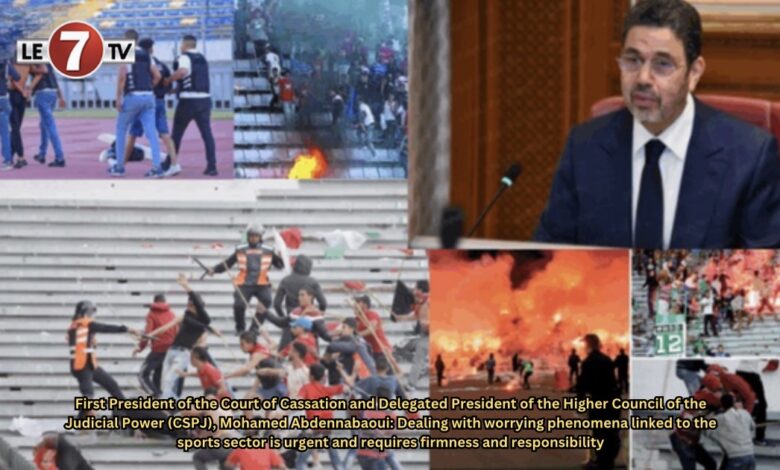
In a speech read on his behalf by the Secretary General of the CSPJ, Mounir El Mountassir Billah, at the opening of the International Scientific Symposium on “the security of major sporting events: security and legal challenges in the era of digital transformation”, Mr Abdennabaoui explained that addressing these phenomena aims to guarantee the sustainability of sport as a school of citizenship, a lever for development and a channel for strengthening national belonging, far from any fanaticism, violence or the spread of hate speech.
This clear strategic orientation constitutes the reference framework of any national approach aimed at securing major sporting events, particularly in a context marked by the scale of organisational challenges, the multiplication of stakeholders and the interaction between the real and digital spaces, he underlined.
Mr Abdennabaoui added that “major sporting events are no longer limited to a simple match in a given stadium, within limited geographical borders, but now constitute a complex event, requiring years of preparation before the official launch, covering cities, infrastructure and means of transport, and extending into the digital sphere through broadcasting platforms, social networks, ticketing and access applications, payment systems and spaces of virtual interaction among millions of spectators”.
In this context, he stressed the danger of new threats, notably cyberattacks targeting digital ticketing systems and event applications, attempts to hack stadium control systems through denial of service attacks or ransomware, as well as the exploitation of public wireless networks to commit fraud and steal personal and financial data.
Morocco, which is preparing for a major global sporting stage with the organisation of the 2030 Football World Cup, is fully aware of the magnitude of this challenge and of what it requires in terms of the overall mobilisation of institutional and human capacities, investment in knowledge and scientific research, modernisation of legal, judicial and security systems, as well as responsible engagement in multilateral international cooperation networks, Mr Abdennabaoui noted.
This three day event is organised by the Ministry of Justice in partnership with the Naif Arab University for Security Sciences of Saudi Arabia, the General Directorate of National Security, the Command of the Royal Gendarmerie and the Royal Moroccan Football Federation, with the support of the United Nations Office of Counter Terrorism, the International Organization for Migration and the Arab Sports Union for Police.
Taking place within the framework of Morocco’s hosting of CAN 2025 and the preparations for the organisation of the 2030 World Cup jointly with Spain and Portugal, this Symposium is marked by the presence of ministers, senior officials and national and international experts representing prestigious institutions, notably the International Federation of Football (FIFA), continental confederations, the United Nations Office of Counter Terrorism, the International Organization for Migration, Interpol, Europol, the Council of Europe, the African Union Commission and the British authority responsible for stadium safety.
It also brings together officials from the justice, interior, security and sports sectors of several countries, as well as researchers and specialists in the fields of sports event security, counter terrorism, cybersecurity and organised crime.
Editorial team/le7tv