Trump wants to “annex” Greenland: Europe discovers its strategic insignificance in the face of American power
European indignation over Donald Trump’s ambitions regarding Greenland stems less from a sincere defense of international law than from a reflex of panic. In reality, the Greenland crisis starkly highlights a truth that Brussels stubbornly refuses to acknowledge: Europe is no longer a major strategic actor, but an anxious spectator in a world being reshaped by the great powers.

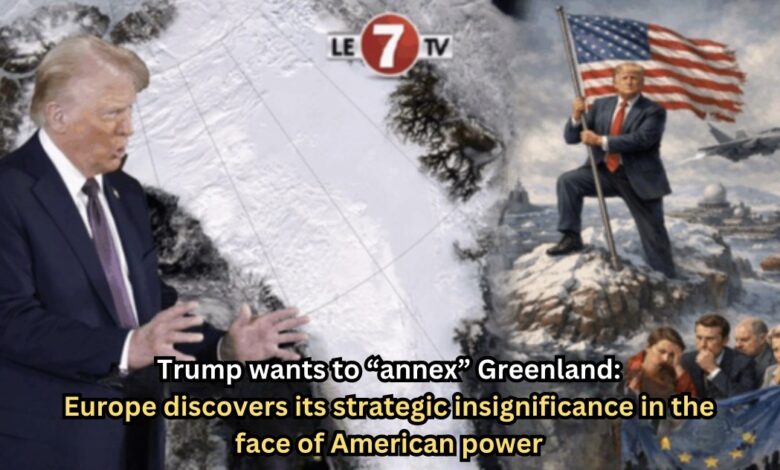
By reaffirming his desire to see Greenland come under American control, Donald Trump is not acting out of improvisation or gratuitous provocation. He is acting according to an openly assumed logic of power, based on national security, control of Arctic routes and access to strategic resources. Where Europe hesitates, Washington anticipates.
American realism versus European idealism:
Greenland is not a simple frozen territory belonging to Scandinavian folklore. It is a central piece on the Arctic chessboard, at the heart of new maritime routes opened by climate change and in immediate proximity to Russian and Chinese zones of influence. The United States has understood this for a long time, as evidenced by its permanent military presence in Pituffik and the defense agreement signed as early as 1951.
In the face of this, what does Europe propose? Statements, moral condemnations and a facade of solidarity with Denmark. The European Union, true to itself, confuses moral posturing with strategy, forgetting that geopolitics is governed neither by slogans nor by endless meetings.
Donald Trump, for his part, speaks the language the world understands: that of the balance of power. He recalls an obvious truth that European capitals prefer to ignore: the security of the West rests above all on American power, not on the illusions of strategic autonomy promoted in Brussels.
A dependent and vulnerable Europe
Danish indignation, widely echoed by European chanceries, barely conceals a deep dependence. A member of NATO, Denmark would have neither the military means nor the political capacity to secure Greenland on its own without the American umbrella. Europe as a whole knows this, but refuses to admit it publicly.
More seriously, this crisis reveals the inability of the European Union to act quickly, to speak with one voice and to effectively defend its interests. While Washington moves its pieces, Europe debates procedures. While the United States secures critical resources, the EU loses itself in ideological considerations.
Trump, the revealer of a new world order:
Whether one likes him or not, Donald Trump acts as a brutal revealer of the new world order. After the American operation against the regime of Nicolás Maduro, he sends a clear message: the United States no longer negotiates its security and its strategic interests. It imposes them.
Greenland fits into this logic. It is not a personal whim, but a coherent vision: to control the key points of the planet before rival powers do. Faced with this, Europe appears disarmed, hesitant and trapped by its own contradictions.
A bitter lesson for Europe
The question, therefore, is not whether Trump “has the right” to want Greenland, but why Europe is incapable of proposing a credible alternative. As long as it remains militarily, energetically and strategically dependent on the United States, its protests will remain ineffective.
Ultimately, the Greenland issue sounds like a severe warning: in the world to come, power decides, weakness protests. And on that field, America moves forward while Europe falls back.
Translated from Abderrazzak Boussaid’s French article – le7tv