Davos (Switzerland): Aziz Akhannouch highlights HM the King’s vision combining “social ambition” and “economic credibility”
“Under the High Guidance of His Majesty King Mohammed VI, Morocco demonstrates that there is no contradiction between social ambition and economic credibility,” said the Head of Government, Aziz Akhannouch, on Tuesday in Davos, Switzerland, in a global context marked by the multiplication of crises and the erosion of traditional economic reference points.

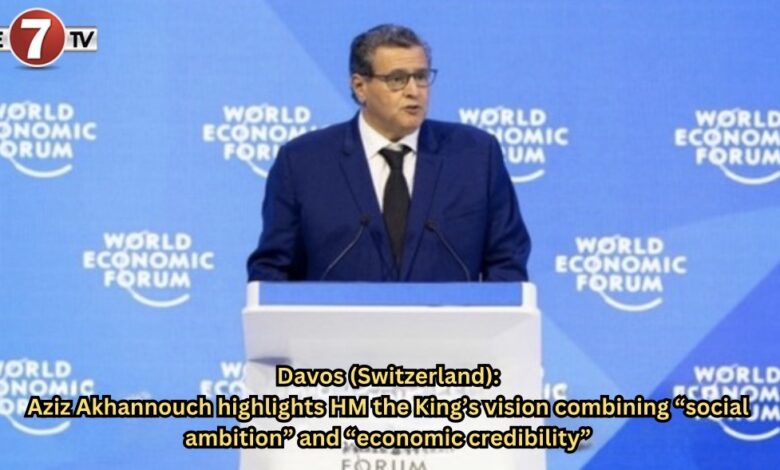
“One does not build a geopolitical destiny on a fragile society,” Mr. Akhannouch stressed in an address to participants at the 56th Annual Meeting of the World Economic Forum (WEF), during a session moderated by WEF Co-Chairman André Hoffmann.
The Head of Government noted that the Kingdom, “under the leadership of His Majesty King Mohammed VI, has chosen first to protect, then to undertake deep reforms, and to project itself forward with confidence,” by establishing a genuine social shield against the effects of the post-Covid crisis. This effort mobilized more than 13 billion dollars to stabilize the prices of basic consumer goods and 1.7 billion dollars to shield households from increases in water and electricity tariffs.
This policy, he explained, made it possible to bring inflation down from more than 6 percent in 2023 to below 1 percent in 2024 and 2025, while maintaining a growth trajectory close to 5 percent and a gradual reduction in the budget deficit and public debt.
“These indicators are essential,” Mr. Akhannouch said, because “only a strong and resilient economy is capable of financing and sustaining the first major undertaking of this government, the Royal Project of the Social State.”
Under the High Royal Guidance, Morocco has thus generalized compulsory health insurance to more than 32 million citizens, while launching direct social assistance for nearly 4 million families. This has gone hand in hand with a historic budgetary effort in favor of health and education, with an increase of nearly 20 percent in allocations to these sectors.
“Protecting without transforming would be an unfinished promise,” the Head of Government also emphasized, highlighting the overhaul of economic fundamentals, which has been welcomed by international partners.
In this regard, he recalled that, in terms of confidence and financial integrity, Morocco has successively exited the FATF grey list as well as related European lists, and has regained “investment grade” status from major credit rating agencies.
These achievements stem from rigorous budgetary discipline, long-term fiscal reforms, strengthened governance of public spending and sustained efforts in transparency, he added. In parallel, the implementation of the Investment Charter has accelerated productive investment, pushing gross foreign direct investment inflows to a record level of more than 5 billion dollars in 2025, despite an international context marked by a contraction of capital flows.
Situated at the crossroads of Europe, Africa and the Atlantic, Morocco is also asserting itself as a major logistics platform, with Tanger Med ranking among the world’s leading ports. At the same time, the Kingdom is positioning itself as a key player in decarbonization, with more than 46 percent of its electricity capacity coming from renewable energy sources by the end of 2025, alongside structuring projects in solar, wind and green hydrogen.
The Head of Government also stressed the importance of political clarity for long-term investment, noting that “the year 2025 will remain a pivotal one” for the Kingdom, particularly in light of the adoption of United Nations Security Council Resolution 2797, which “sends an unambiguous signal to the international community: the Moroccan Autonomy Initiative for the Southern Provinces is recognized as the basis for negotiations.”
Turning to the co-organization of the 2030 World Cup by Morocco, Spain and Portugal, Mr. Akhannouch described it as “a symbol that is at once sporting, economic and civilizational,” stressing that “far from being an end in itself, the World Cup is a milestone in a strategy of transformation.”
The exchange that followed with Mr. Hoffmann allowed the Head of Government to revisit, in particular, the Africa Cup of Nations (AFCON 2025), which, according to him, demonstrated how Morocco succeeded in delivering a “world-class” organization of “one of the finest football competitions,” with a welcoming population and “a final worthy of a World Cup.”
He took the opportunity to recall that the 2030 World Cup, beyond being an opportunity for developing sports infrastructure, is intended as an “accelerator of development,” highlighting projects completed or underway in rail, airport and road infrastructure, as well as in health and education, to which Moroccans are proud to contribute.
Mr. Akhannouch also underscored the “unprecedented” decision to co-host the World Cup with Spain and Portugal, countries with which Morocco maintains excellent relations, pointing to the advantages this offers in terms of geographical proximity, shared time zone and Mediterranean climate.
For his part, the WEF Co-Chairman stressed that citizens’ love of football is a decisive factor in the success of such an event, ensuring that sport serves as a unifying force and a source of cohesion for both shores of the Mediterranean.
He also congratulated Morocco for the stability it enjoys under the leadership of His Majesty the King, its ongoing modernization efforts and its ability to build “a functional social state,” noting that these are all factors that make the country “fascinating” and “attractive to investors.”
Editorial team/le7tv