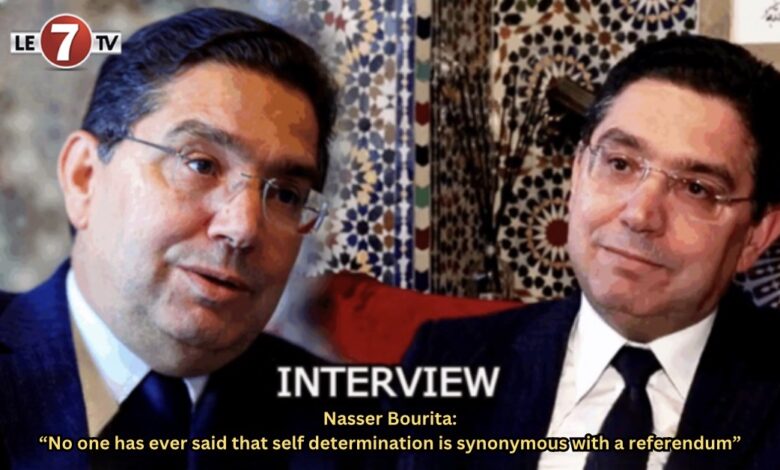
Nasser Bourita: “No one has ever said that self determination is synonymous with a referendum”
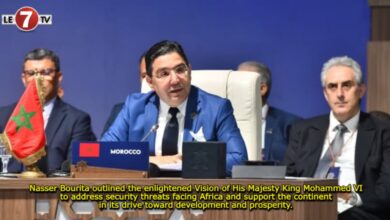
Morocco’s Minister of Foreign Affairs, Nasser Bourita, stated in an interview with the EFE agency in Madrid that “nowhere is it said that the right to self determination is a referendum”, explaining that it is a “will” that can be expressed in other forms.

Question: How did Morocco receive the UN resolution of 31 October?
Answer: “As a break from everything the United Nations had done until now. This resolution clarified the basis of the negotiations, which is the Moroccan autonomy plan of 2007. It specified the final objective of the negotiations, a real autonomy under Moroccan sovereignty. It clarified who the parties are, Morocco, Algeria, Mauritania and the Polisario Front. And it set out the timetable for these negotiations. For once, we have a resolution that defines the parameters of the issue, the roadmap of the negotiations and their objective.”
Q: And how do you assess the Spanish position?
A: “I think that Spain and the president, Pedro Sánchez, were the first to understand that there is an international will to make autonomy the anchor point of any solution. In the 2022 declaration, Spain stated that the Moroccan autonomy plan was a serious and credible basis for the solution. Today, the Security Council has confirmed the position adopted by President Sánchez.”
Q: And now, what comes next?
A: “The resolution must be implemented. It calls on the parties to engage in negotiations on the basis of Morocco’s autonomy plan in order to reach a solution that is just, lasting and mutually acceptable. In his speech of 31 October, Mohammed VI announced that Morocco would update and expand its autonomy plan. The plan was prepared in 2007, eighteen years have passed and many things have changed in Morocco since then. We have a new Constitution since 2011, a charter of regionalization since 2015, a new development model. Also, the region around us has changed, the world has changed.
Second, in 2007 the autonomy initiative was a diplomatic initiative. Now that the Security Council has made it the basis of the solution, it must be more detailed. It now becomes a plan, and no longer only an initiative. Consultations have taken place with political parties, because it is an issue that concerns all Moroccans. Then, Morocco will present this detailed and updated plan, and I think there will be negotiations on the basis of the resolution and, therefore, on the basis of the autonomy plan.”
Q: Will Morocco negotiate with the Polisario Front?
A: “The resolution defined the four parties that must be present at the negotiating table. Morocco will engage clearly with the three other parties identified in the resolution. Morocco therefore does not have to comment on the presence or absence of the Polisario. Morocco will align itself with and respect what is set out in the resolution.”
Q: Have discussions already taken place with the other parties?
A: “No. We are waiting for the process to be launched by those who will manage this negotiation. There is therefore no date. Morocco is waiting to be invited to a negotiation at the appropriate moment, but this is something that must be coordinated. The resolution clearly refers to the United States as the country that must host the negotiation. They therefore also have a role to play.”
Q: And in this process, what does Morocco expect from its European partners?
A: “Morocco hopes that this issue will be definitively resolved. By presenting the autonomy plan, by creating a dynamic in favor of autonomy and by working for a resolution to be found, Morocco has done everything possible for this issue to be settled so that we can move forward on many subjects and develop our partnership with the European Union.”
Q: What guarantees does Morocco offer to the Sahrawi people…
A: “To the population.”
Q: … regarding the right to self determination?
A: “The fact that this autonomy plan is at the center means that there is a general awareness that it is a legally relevant basis, legally solid and in accordance with the United Nations Charter and with the principle of international law. When countries such as Spain, France, the United Kingdom, the United States, Germany and the Netherlands support this autonomy plan, they are not acting in favor of something that goes against international legality.”
Q: But the resolution speaks of respecting the right to self determination.
A: “Nowhere is it said that the right to self determination is a referendum, what is said is that the right to self determination is allowing the parties to express a will. I do not think that when a person signs an agreement after a negotiation, they are not expressing a will. If we take Spain’s position on Gaza, it says that there must be an agreement signed between Palestinians and Israelis, it does not speak of a referendum to see if everyone agrees. The expression of the will of the parties after a negotiation, when they sign a document, is the expression of a will. We have no problem with self determination, but we are against restrictive, anachronistic interpretations for political purposes. No one has ever said that self determination is synonymous with a referendum, this does not appear anywhere. Therefore, if we want to read the resolution in a clear and lucid way, it is simple. If we want to interpret it politically and orient it, that is something else.”
Q: You previously mentioned that it concerns the population. Do you not think there is a Sahrawi people?
A: “No, it concerns a population. The resolution speaks of people. For us, people means population. And of course, there is no people, there is a population native to this region and Morocco interacts with it.”
Q: Would Morocco accept an international supervision mechanism for the implementation of the future autonomy plan?
A: “No. I think that once autonomy is signed, it will be implemented. Why an international mechanism? I do not think that… In any case, these are questions that will be discussed in the negotiations. But Morocco believes that the international community has given it its trust by supporting its autonomy plan.”
Q: Concerning the airspace of the Sahara, has Morocco proposed today to Spain the transfer of its management?
A: “This is one of the issues clearly highlighted in the declaration of 7 April 2022. A working group was created to manage the issue of airspace and has met several times. We have made progress and, of course, it is a subject that is discussed at every meeting, including today. I think the working group will meet soon to move this issue forward.”
Q: Is Morocco’s position the transfer of this management?
A: “What Morocco says is that today there is no issue that Morocco and Spain, in the spirit of the current relationship, trust, mutual respect, partnership and ambition, cannot resolve. For Morocco, anything that is anachronistic must be updated. Morocco and Spain have the ability to find imaginative solutions to all questions that preserve their mutual interests.”
Q: Does Morocco therefore consider Spain’s management of the Sahara airspace to be anachronistic?
A: “Morocco starts from a simple fact. If you take a plane and want to go to the Sahara, you pass through Marrakech and it is clear which control tower guides you. If there is a problem with the aircraft, who handles it? Who is responsible for the safety of the aircraft? It is Morocco. In bilateral respect, we can find solutions that preserve Spain’s interests while taking into account Morocco’s realities and rights.”
Editorial team/le7tv