Sport as a Vehicle for Promoting Human Rights: What Impact on Societies?
The role of sport in promoting human rights, strengthening social cohesion and consolidating democracy was at the heart of an international symposium held Tuesday in Salé, at the initiative of the National Human Rights Council (CNDH) and the Maroc 2030 Foundation.

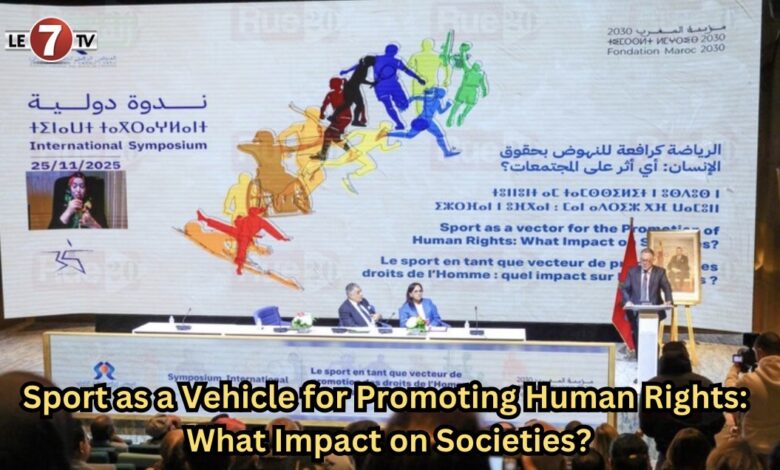
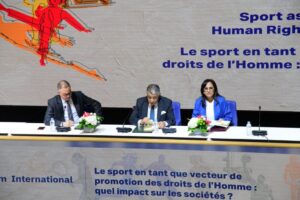
Held under the theme “Sport as a vector for promoting human rights: what impact on societies?”, the event aims to explore the links between sport and human rights, both in normative frameworks and in contemporary social and cultural practices.
Its objective is to discuss high-impact sports initiatives led by young people, associations, local authorities or public institutions, as well as public policies aimed at improving access to culture and sport, while highlighting the role of sport in combating discrimination and hate speech.
In an opening address, the President of the National Human Rights Council (CNDH), Amina Bouayach, stressed that the relationship between sport and human rights has seen a qualitative evolution through the integration of human rights standards into international sports policies.
Given the growing interest in sport and its connection to issues of social justice, the Office of the United Nations High Commissioner for Human Rights has gradually developed international guidelines on the matter, Ms. Bouayach explained.
She also noted that the sports field represents, for the National Human Rights Council, a relevant space for identifying economic, social and cultural transformations, adding that the CNDH has observed the emergence of innovative social sports initiatives and an increasing presence of women and children in sports spaces, making it an important area of work to preserve and strengthen human rights achievements.
In its assessment of the human rights situation within Morocco’s bid to host the 2030 FIFA World Cup, she said, the CNDH formulated recommendations on various aspects related to fundamental rights, development, citizen participation, protection of vulnerable groups, and the consolidation of governance principles in the management of sports and community spaces.
In this regard, Ms. Bouayach stated that such occasions represent, for national human rights institutions and for the CNDH in particular, an opportunity for reflection to refine the human rights system in relation to sport, in order to explore prospects for structural reforms ensuring the sustainability of achievements within a legacy built on a human rights approach.
For his part, the President of the Maroc 2030 Foundation, Fouzi Lekjaa, emphasized the need to use sports practice to instill strong social values that contribute to building a developed society that respects human rights, ensures territorial justice and strengthens gender equality, which he described as essential to support the presence of women and their economic empowerment.
Mr. Lekjaa stressed that sport in general, and football in particular, can play a central role in development and in introducing young people to the principles of coexistence, respect for others and acceptance of diversity, as demonstrated by the national teams in all categories, characterized by diverse profiles.
For her part, the Vice President of the International Olympic Committee, Nawal El Moutawakel, stated that sport is a universal language capable of bringing people together, elevating and transforming them, as it transcends borders, cultures and social conditions, adding that it holds a unique power, “that of advancing the values of equality, dignity and respect”.
Ms. El Moutawakel also highlighted the driving role sport plays in achieving gender equality, enabling women and girls to occupy public spaces, express their potential, build confidence and autonomy, and become sources of inspiration for future generations.
According to her, “promoting equality in sports practice, in its supervision and in its governance is contributing to building a more just, more balanced and stronger society”.
According to Gerd Dembowski, Acting Head of Human Rights and Anti-Discrimination at FIFA, the commitment of the International Federation to human rights is enshrined in its statutes, affirming that FIFA is fully aware of its responsibility to respect human rights in accordance with the UN Guiding Principles on Business and Human Rights.
For him, adopting a human-rights based approach is a key element in the preparation of sporting events, including the 2030 World Cup. This approach, he noted, requires strong transparency, ranging from human rights commitments presented by bidding candidates to the independent evaluation of the human rights context by national institutions, and finally to FIFA’s assessment during the bidding stage.
On the sidelines of the symposium, a memorandum of understanding was signed between the CNDH and the Maroc 2030 Foundation, aimed in particular at organizing joint forums and meetings on sport and human rights, as well as strengthening the capacities of various stakeholders in these fields.
Work during the event focused on themes such as “practices in human rights and sport”, “sport in its relationship with human rights”, “sport as a vehicle for promoting equality and social inclusion”, and “culture, sport and human development”.
This event is intended to serve as a platform for reflection to draft a document summarizing the main findings, orientations and recommendations resulting from the discussions. This document will form a shared reference framework for continuing the work and strengthening the progress made.
Editorial team/le7tv