Casablanca: Groupe Renault Maroc signs collective agreements with its social partners
Groupe Renault Maroc has taken a new step in strengthening its social dialogue by signing, on Wednesday in Casablanca, collective agreements covering all of its industrial and commercial entities.

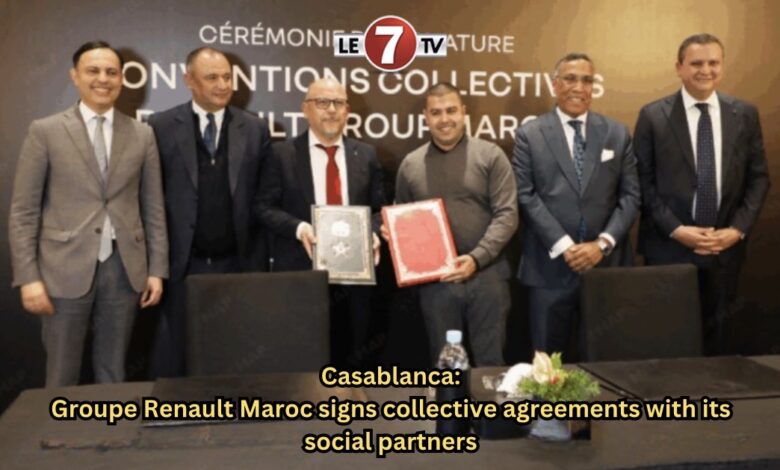
Concluded with the Democratic Confederation of Labour (CDT) for the SOMACA plant and Renault Commerce Maroc, and with the Moroccan Labour Union (UMT) for the Tangier plant, in the presence of the Minister of Economic Inclusion, Small Business, Employment and Skills, Younes Sekkouri, and the Minister of Industry and Trade, Ryad Mezzour, these agreements establish a clear and shared framework with social partners regarding working conditions and social rights for more than 10,000 employees.
They mark key milestones for each of the group’s entities. The Renault Group plant in Tangier is renewing its commitments for the third time since 2017. The Casablanca plant (SOMACA) is signing its third agreement since the site was taken over by the group in 2005, while Renault Commerce Maroc is signing its very first collective agreement with its social partners.
Speaking on this occasion, Mr. Sekkouri stressed that these agreements reflect the image of a modern Morocco that knows how to combine the vital interests of workers and the interests of the company and competitiveness. The minister expressed his satisfaction with the provisions included, particularly the priority given to hiring the children of current and retired employees, describing this measure as a significant mark of recognition.
He also commended the organisation of social dialogue and the support system for increases in activity in the event of new production lines or fluctuations in the international context.
For his part, Mr. Mezzour insisted on the need for the Moroccan automotive sector to further diversify instead of focusing solely on costs. He called on Groupe Renault Maroc to accelerate its move upmarket and into higher categories. Referring to the union that works alongside the company, the minister emphasized the importance of having technically skilled representatives capable of meeting the sector’s challenges.
For his part, the General Director of Groupe Renault Maroc, Mohamed Bachiri, expressed his pride in taking this decisive new step in the structuring of the group’s social model and in the consolidation of a lasting dialogue with social partners. He recalled that Morocco holds a strategic position in Renault’s global industrial system, with nearly one in five vehicles sold internationally manufactured in the Kingdom.
Mr. Bachiri stated that these collective agreements are the result of extensive work carried out in a spirit of responsibility and mutual trust, reflecting a shared commitment to establishing a clear and common framework for working conditions and social rights. He affirmed that human capital is at the heart of the group’s success in Morocco and that these agreements contribute to the emergence of a new social dynamic focused on listening, sharing and collective progress.
As for the Secretary General of the UMT, Miloudi Moukharik, he described these collective agreements as modern and sectoral, noting that the union had always advocated for them since the creation of the plant. A company like Renault deserves professional relations that go beyond the basic labour code, which he referred to as a social minimum wage framework. Mr. Moukharik explained that the collective agreements take into account the specific nature of the sector and open new perspectives in terms of career development, dialogue and the improvement of working conditions, hygiene and safety.
For his part, the Secretary General of the CDT, Khalid Alami Houir, stated that these collective agreements represent a significant advancement in the structuring of professional relations within Groupe Renault Maroc. He highlighted the importance of this contractual framework, which guarantees workers’ rights while taking into account the company’s competitiveness requirements. Mr. Alami Houir praised the quality of the social dialogue that led to these agreements, reflecting the maturity of relations between management and social partners.
Renault has been established in Morocco since 1928 and is the undisputed leader of the national automotive market. More than one in three vehicles sold in Morocco are marketed by the group through its two brands, Renault and Dacia.
Editorial team/le7tv